


The climate crisis is a crisis of coordination. Full stop.
Addressing the climate crisis requires every facet of modern society to act in concert. Governments at every level, labor, industry, civil society, and culture must remain responsive to one another and to the nonhuman world on which human life depends.
The challenge is monumental, and our capacity to organize the people, institutions, knowledge, and resources required to meet it is being systematically undermined by the corruption of the very symbolic order through which we understand our lived experience and make it intelligible to one another.
That corruption is the crisis of perfect music.
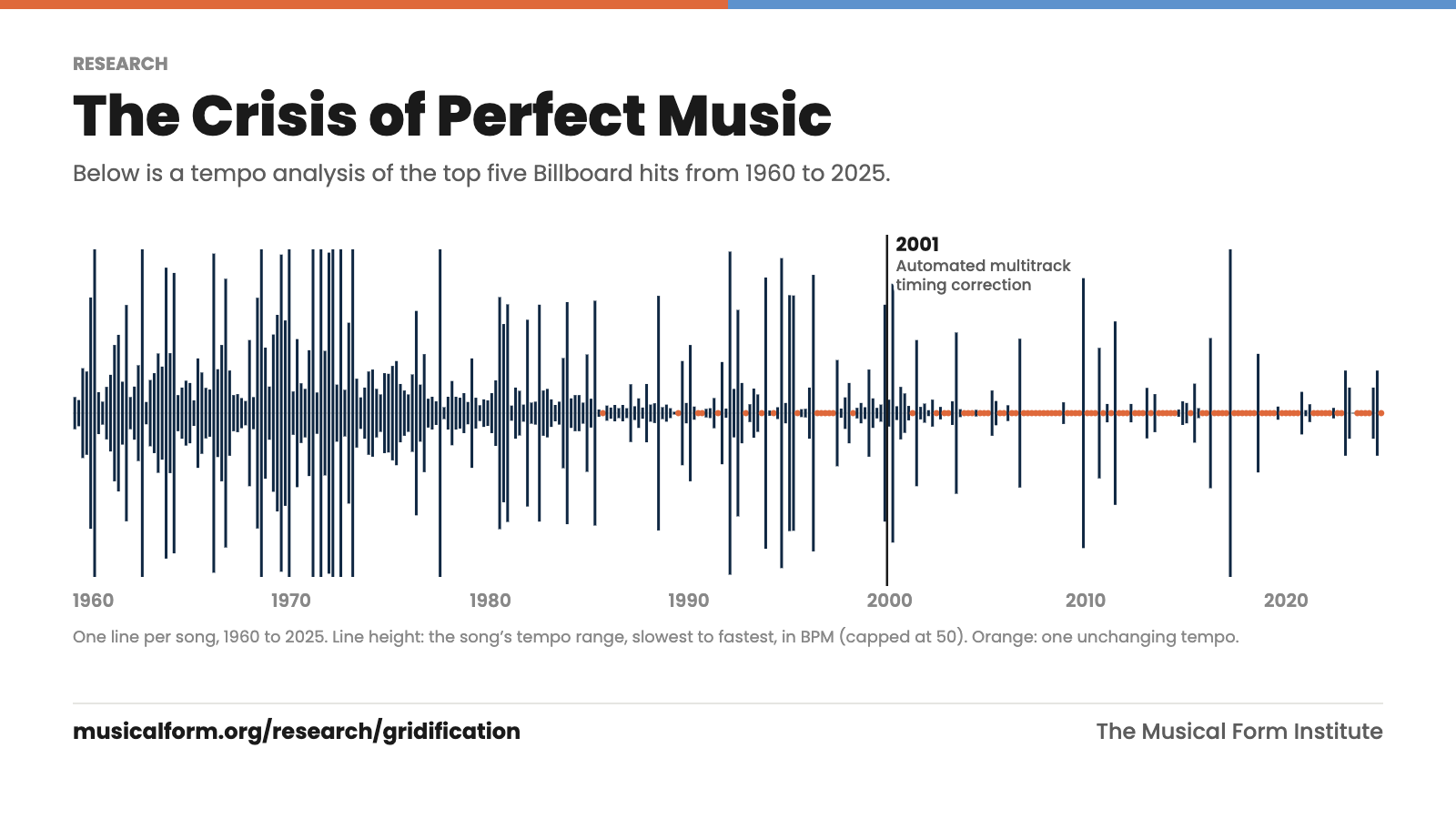
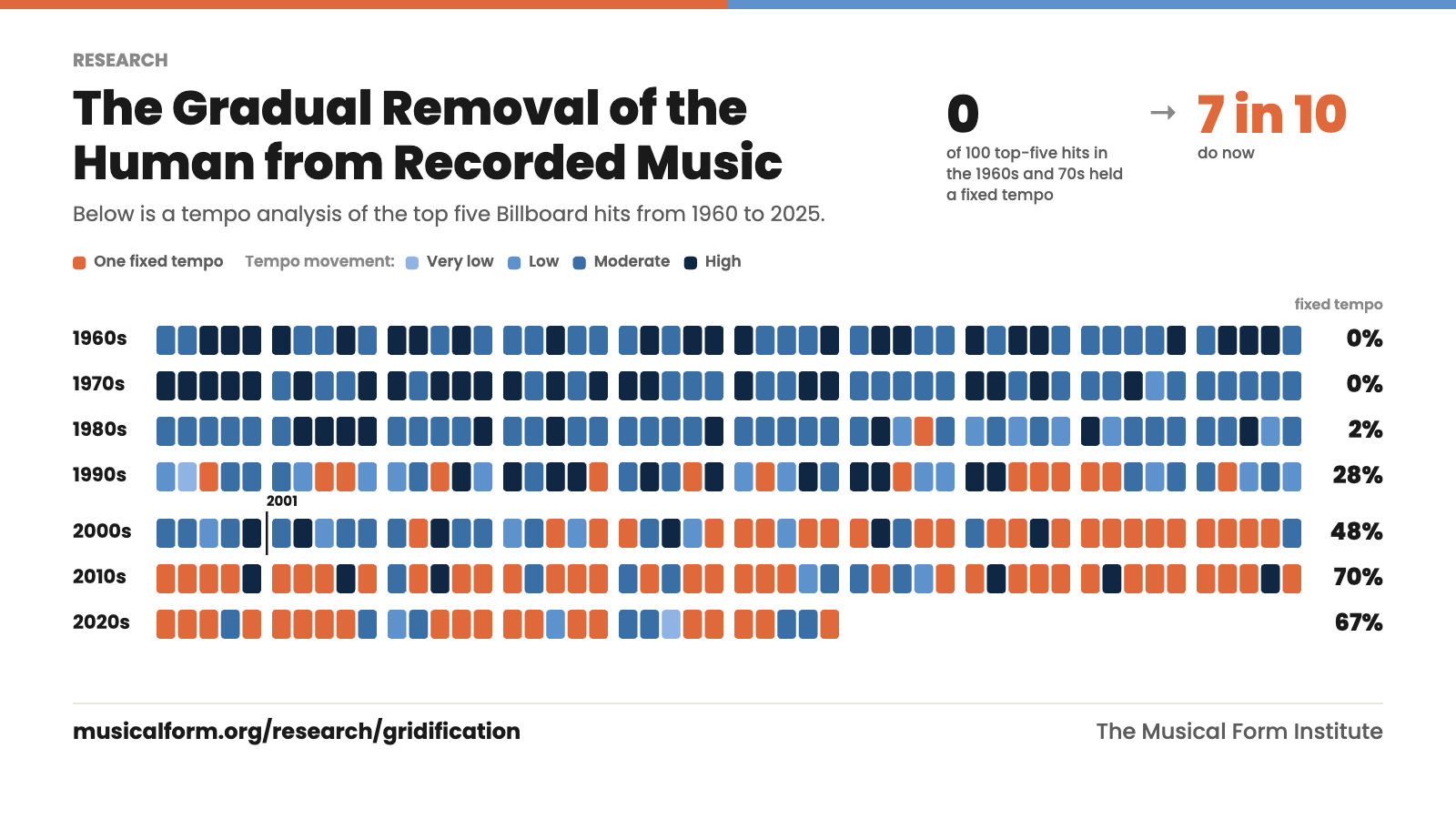
The graph above shows the tempo movement of the top five Billboard hits for each year from 1960 to 2025. Each blue line represents the tempo range of one recording. Each orange mark represents a recording with one unchanging tempo. Across the 50 top-five recordings from the 1960s, every recording showed measurable movement in tempo. From 2016 through 2025, 35 of 50 showed no movement in tempo at all. Put another way, 70% of the top five hit songs from 2016 to 2025 had machine-perfect time, a time no human exists in.
What we are witnessing is the gradual removal of the human from recorded music through a modern production process I call gridification: the post-performance alignment of human-performed timing to a machine-defined grid.
Gridification treats the temporal relationships through which musicians express their historically positioned voices as deviations from a machine-defined standard and corrects them out of the recording. This exposes a contradiction our culture has yet to confront: at the same historical moment that we have rightly come to privilege the primacy of one’s own historically positioned voice, we have normalized production practices that erase the history of the body and its place in time. When you gridify a performance or tune a vocal, you are silencing the very voice we claim to value. Generative AI carries this logic to its conclusion by removing the historically positioned human being from the production of the sonic object altogether.
The result is a culture saturated with perfect music. Perfectly placeless, voiceless, and timeless (derogatory), these recordings are entirely interchangeable with one another. These sonic objects are now being replicated at inhuman scale by machines that produce the smoke of a performance whose fire never burned.
The Symbolic Order
Music is the primary way human beings make the experience of living together in time intelligible to one another. That is, music gives objective form to lived time.
In an embodied performance, we hear and feel the distinct form of a shared world. The dense, complex, concurrent fabric of feelings that rise, ebb, intensify, and resolve within each of us is presented in the sound of a musical performance and preserved in its recording.
Perfect music presents another world entirely, one ordered by a form of time no human actually inhabits. It presents an image of collective life in which order can be achieved only once human difference has been measured against an external, machine-defined standard and “corrected” into compliance with it.
This is the symbolic environment we are saturated in, one that systematically removes the forms of embodied negotiation through which human beings learn to coordinate across difference.
Yet from within this environment, we are now demanding the largest act of human coordination in history.
Synchronization Without Coordination
Synchronization and coordination describe two different forms of order.
Synchronization aligns everyone to an external measure. Coordination is generated among distinct people who remain responsive to one another and, through that responsiveness, become responsible to one another for the time they make together. Together they build a common time negotiated from within their difference.
The work of the American philosopher Susanne Langer allows us to understand how vital this process of coordination is at the cultural scale. She argued that the arts we live with—music, painting, dance, theater, architecture—actually form our emotive experience.
“Every generation has its styles of feeling. One age shudders and blushes and faints, another swaggers, still another is godlike in a universal indifference. These styles in actual emotion are not insincere. They are largely unconscious—determined by many social causes, but shaped by artists, usually popular artists of the screen, the juke-box, the shop window, and the picture magazine. Irwin Edman remarks in one of his books that our emotions are largely Shakespeare’s poetry”
Susanne Langer, “The Cultural Importance of the Arts” (1966), p. 11.
Music gives temporal form to that style of feeling. When a recording preserves the embodied performance of particular people in a particular place and time, it makes a culture’s particular time perceptible. It is the sound of distinct people becoming responsible to one another for the world they are producing together.
Machine-perfect music gives form to another time altogether, one that precedes human relation and requires no negotiation because every relationship has already been predetermined by the grid. Responsibility, in this world, has been solved in advance—you are no longer responsible to the people with whom you are making time, or to the dynamic unfolding of a community whose future depends upon your continued responsiveness to one another; you are responsible only to the predetermined measure, which has already decided what the relationship should be.
What we hear today in our earbuds, in the homogenized perfection of Spotify playlists, in supermarkets and car stereos, underneath podcasts, television commercials, and YouTube videos is synchronization without coordination—the sound of compliance presented as the successful creation of a common world. What remains are sonic objects that present machine representations of human-produced music—the perceptual form survives, but the human relations through which those forms of feeling were produced have been corrected out, leaving us surrounded by representations of human feeling in which no one remains responsible to anyone else.
The climate crisis cannot be met by correcting every difference into a single external order. Nations, cities, industries, communities, and ecosystems inhabit different histories and face different stakes; coordination at this scale requires those differences to remain present while a common course is negotiated from within them. Perfect music narrows our capacity to meet this challenge by making compliance feel like coordination and the reproduction of a predetermined order feel like collective achievement. It does the cultural work of the status quo by teaching us to hear the absence of negotiation as harmony.
So What Do We Do?
For the past several years, I have been trying to understand why, even though we possess immense catalogs of political theory and public policy knowledge, along with more technological capacity and material resources than at any point in history, our ability to get anything done together seems to be getting worse.
Why do we have so much knowledge and so little collective capacity?
Why are we becoming less able to understand one another at the exact moment we most need to?
I read about symbolic logic, the history of communication, knowledge formation, meaning-making, and the ways human beings construct a shared reality, and somewhere in that process I ended up back where I started, in music. I had spent 25 years as a session and touring musician, but I had never understood recorded music as part of the infrastructure through which a society learns how to live together. Once I had that epiphany, the next question was obvious: If perfect music is systematically removing the embodied negotiations through which we learn to coordinate across difference, how do we begin putting those forms back into the world?
That question led to the Musical Form Institute and the Certificate of Embodied Production. Launched earlier this year, the CEP is a public certification standard for recordings made without post-performance grid correction, pitch correction, or generative AI; it identifies recordings in which the historically positioned voices and embodied relationships erased by perfect music remain present.
The standard, certification process, and research discussed here are available on our website. We have also applied to register the Certificate of Embodied Production with the U.S. Patent and Trademark Office as a federal certification mark, alongside established certifications such as USDA Organic, Fair Trade Certified, and UL Certified. After nine months of review, the application has crossed its final substantive threshold, and we expect federal registration to be issued once we submit evidence that the CEP is in commercial use.
The CEP is currently in public beta, and certification is free while we continue testing the process with musicians and producers. We invite you to submit your music for certification and help us build a public record of recordings in which the human remains present.
If you would like to support this mission, become a paying subscriber to this Substack or support us directly through our website. Your support will help us keep certification accessible, bring the CEP to more musicians and producers, and make embodied music visible in a culture increasingly organized around its disappearance.