



Part One: Introduction
Something happened to recorded music over the last twenty-five years that most people can hear, and feel, but almost nobody has the language for. At the Musical Form Institute, we call this change gridification.
The simplest way to show what we mean is to listen.
Start with the top five songs on the Billboard Hot 100 from 1975:
1975 Billboard Hot 100 Top 5 Songs

No.  Title                              Artist(s)
1    “Love Will Keep Us Together”       Captain & Tennille
2    “Rhinestone Cowboy”                Glen Campbell
3    “Philadelphia Freedom”             Elton John
4    “Before the Next Teardrop Falls”   Freddy Fender
5    “My Eyes Adored You”               Frankie Valli
With the top five from 2025:
2025 Billboard Hot 100 Top 5 Songs

No.     Title                    Artist(s)
1    “Die with a Smile”       Lady Gaga and Bruno Mars
2    “Luther”                 Kendrick Lamar and SZA
3    “A Bar Song (Tipsy)”     Shaboozey
4    “Lose Control”           Teddy Swims
5    “Birds of a Feather”     Billie Eilish
1975
Let’s start with Captain & Tennille’s Love Will Keep Us Together:
What hits me immediately on this track is that the kick and bass do not line up exactly. You never hear that in a contemporary pop mix anymore. That is not because musicians lost the ability to play together. Quite the opposite. Modern session players have incredible chops and extraordinary time. It is because modern music production now treats human temporal particularity as error in need of correction.
There is also a really remarkable rhythmic figure in the second-to-last measure of the chorus, a kind of herky-jerky shape, basically a sixteenth tied to a dotted eighth pattern. It would almost certainly not survive a modern pop production. A producer might smile at it, maybe even say they like it, but they would still ask for a few more passes, something simpler, you know, “don’t get in the way of the vocals,” and then playlist those takes in Pro Tools, with the simpler version making it into the final mix.
Also there is a fill into the bridge that is even more revealing. Hal Blaine rushes into it and then pulls the time right back. If you look at the tempo analysis, you can see this clearly. In a contemporary production workflow, that would certainly be grid-corrected during the mixing session.

What modern production calls “correction,” and mistakes for care, is really a form of epistemic violence against the record of human beings objectifying felt time for our understanding. But more on the stakes later in this introductory article.
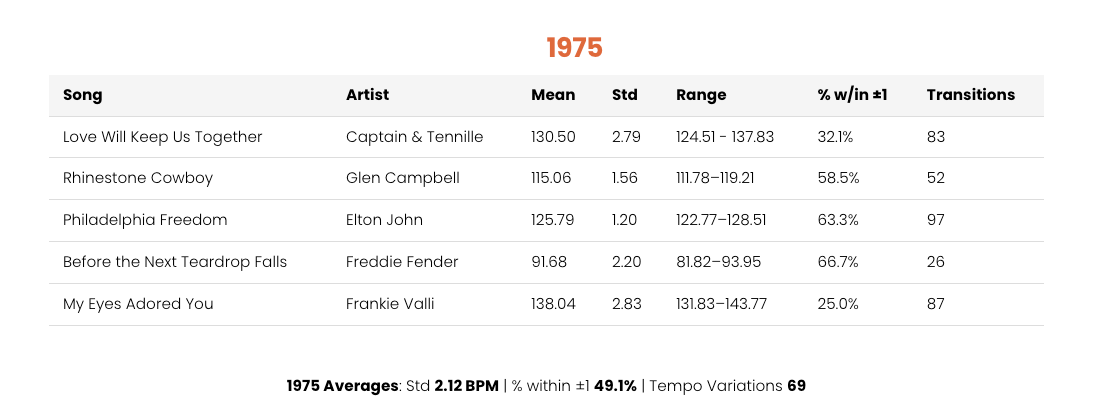
Let’s look at the data. Abstracted numbers are, after all, our preferred mode of contemplation:
Mean tempo:                130.50 BPM
Standard deviation:        2.79 BPM
Range:                     124.51 to 137.83 BPM
% within ±1 BPM of mean:   32.1%
Tempo transitions:         83
Measure BPM
1|2|3 124.5593
2|2|3 125.8507
3|2|3 124.6132
4|2|3 127.7416
5|2|3 125.6448
6|2|3 127.8976
7|2|3 126.3712
8|2|3 128.2008
9|2|3 127.1523
10|2|3 129.1668
11|2|3 127.5507
12|2|3 130.3373
14|2|3 130.9105
15|2|3 128.5513
16|2|3 130.1077
18|2|3 130.9254
19|2|3 129.9382
21|2|3 127.4068
22|2|3 129.6392
23|2|3 127.8969
25|2|3 129.2653
29|2|3 128.6863
30|2|3 131.2192
31|2|3 129.1016
33|2|3 131.3838
34|2|3 129.5663
35|2|3 128.5369
36|2|3 130.5412
38|2|3 130.0519
39|2|3 132.1934
40|2|3 129.9257
41|2|3 128.7726
43|2|3 129.7238
44|2|3 131.8771
44|4|3 134.2031
45|1|3 137.8320
45|2|3 128.2465
46|2|3 132.5112
47|2|3 129.9052
48|2|3 134.3973
49|2|3 132.3194
50|2|3 131.2326
52|2|3 129.2117
56|2|3 130.9343
57|2|3 129.2254
59|2|3 131.0356
61|2|3 131.7369
63|2|3 129.6771
64|2|3 127.8253
65|2|3 131.4048
66|2|3 128.8244
67|2|3 133.6194
68|2|3 130.9984
69|2|3 133.1945
70|2|3 128.0227
71|2|3 132.1578
73|2|3 130.0754
74|2|3 131.5729
75|2|3 129.9902
76|2|3 128.7935
78|2|3 130.5767
80|2|3 131.9270
81|2|3 130.7515
82|2|3 132.7510
84|2|3 136.5559
85|2|3 131.1953
86|2|3 132.2898
88|2|3 132.5448
89|2|3 131.4873
91|2|3 124.5055
91|4|3 127.5606
92|2|3 131.3748
93|2|3 129.1769
94|2|3 126.8247
95|2|3 131.9519
97|2|3 132.5867
99|2|3 132.7204
100|2|3 136.0640
101|2|3 134.6439
103|2|3 135.2255
104|2|3 133.5280
106|2|3 137.0205
107|2|3 135.1272
108|2|3 133.47392025
OK. Let’s look at the #1 hit song from 2025, Die With a Smile by Bruno Mars and Lady Gaga:
What hits me immediately is how perfect the vocals are. There are melodic leaps in the verse that are incredibly difficult to nail, and Bruno Mars is hitting every single note pitch-perfect and in absolutely perfect time.
When the drums come in, wow. Big, warm tom tones. Not much decay either, which is interesting, because a modern drum will usually ring unless you mute it with something like a handkerchief or MoonGel. To my ears, those tones sound controlled in post. And I also notice just how locked everyone is. Absolutely no separation between the kick and bass, and the guitar rhythms are right smack in there, just perfect time. I mean, to my trained ears, these are monster players who just delivered a performance at a level very few humans ever reach.
OK let’s do our tempo analysis:
Mean tempo:                79.00 BPM
Standard deviation:        0.00 BPM
Range:                     79.00 to 79.00 BPM
% within ±1 BPM of mean:   100.0%
Tempo transitions:         0
Measure BPM
1|1|1 79.0000I did not forget to copy and paste anything here. I performed the same exact tempo analysis for this song, and it produced zero tempo transitions. Down to, what is that, one ten-thousandth of a BPM?
Remarkable, right? A room full of musicians played together over the course of a roughly 4-minute song, and they are absolutely machine-perfect.
Well okay, we know no human being is capable of playing an instrument and maintaining a tempo with zero variance down to one ten-thousandth of a BPM, because we are human beings and not machines.
This is gridification.
Before we get to why it matters here is the rest of the data:
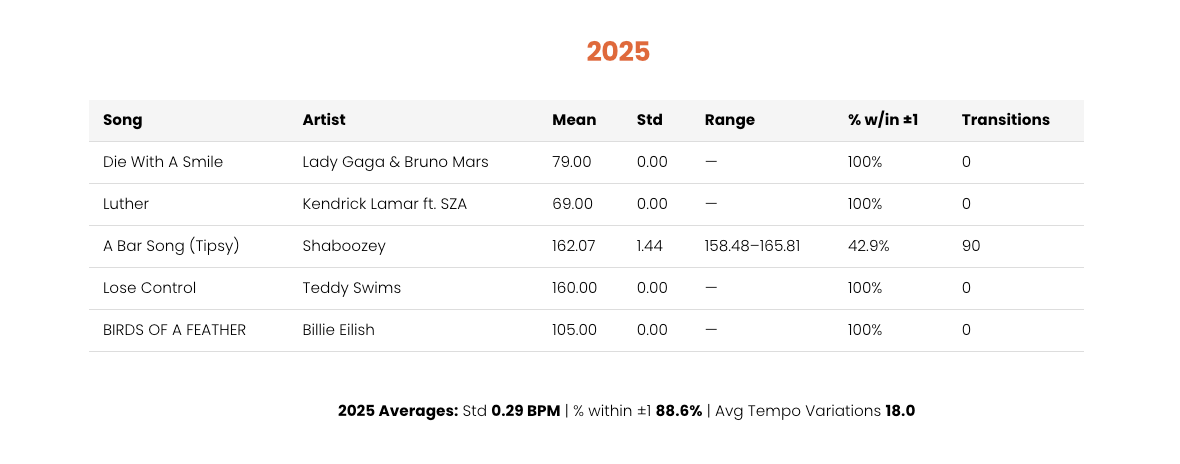
You may have noticed that one song in the 2025 group has actual movement: Shaboozey’s A Bar Song (Tipsy). I was curious about that too, so I went looking for how it was made. In a Sound On Sound interview, the producers explain that the song began as a voice memo that Shaboozey sang with his guitar at the end of a long day in the studio. They then spent the next several days trying to recreate it with expensive microphones, but they could not capture that magical feel of that voice memo take. So instead of replacing it, they built the song around the voice memo.
This part of the interview stood out:
“We were only showcasing four songs,” says Sastry, “and although we had not quite completed the production of ‘A Bar Song’, we decided that we had to perform it. So the three of us performed the song with a backing track that was pretty close to what the world would eventually hear. The reactions were crazy. We saw everybody from everywhere in the bar run to the stage. […]
“I’ve never seen anything like it,” agrees Cook. “When the pre‑chorus started, 20 people immediately walked in from the other room, asking, ‘What song is this?’ It’s the first time I’ve ever seen the energy shift instantly like that! Apparently, the show also led to Shaboozey being invited to appear on her album. That night and that song are such a launching pad for everything, it’s crazy.”
I would wager people’s ears perked up because they were feeling something that almost all modern pop music has silenced: the objectification of lived time.
Let’s look at a few more abstracted numbers before diving into the why it matters part:
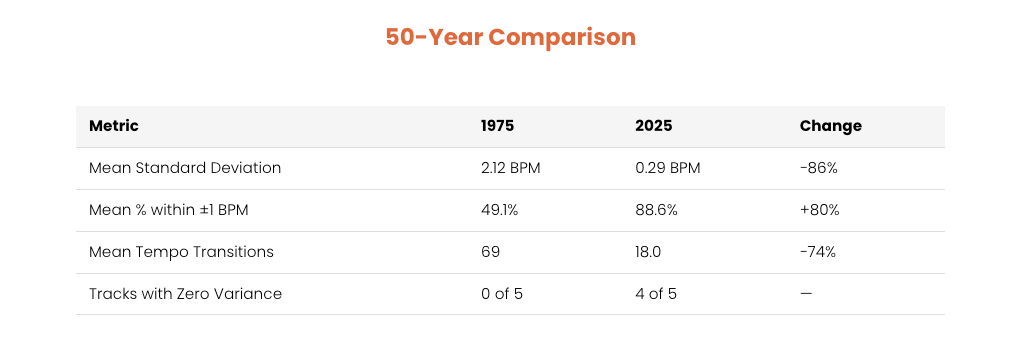
Take out the Shaboozey song and modern pop music is reduced to machine-perfect representations of human-produced music.
What is Gridification Then?
Gridification is when a human performance is treated as error in need of correction and turned into a machine-perfect representation of itself.
That means taking the performances of musicians in the studio and applying algorithmic quantization tools to the recorded audio after the fact.
It also includes grabbing a kick drum, a bass articulation, or any other performed element and sliding it into alignment with the rest of the song.
In other words, gridification is any post-production temporal adjustment to performed material after the performance has already happened.
But what about tracking to a click, a loop, a tempo map, a DAW, tape, or even direct to lathe? What about tracking with a synth, a MIDI controller, Ableton Live, a looper pedal, a sampler, or whatever else?
None of that is gridification.
And what about punching in because you hit an F-sharp over the D-minor on the bridge? Yes. Punch it in. Punch-ins preserve the continuity of felt time in a way that comping from different takes does not. In fact, playlisting for comping purposes is strongly discouraged. That is the modern infinite-undo mindset at work. It removes the stakes of lived life that we inhabit from the performance.
And what about dance music? Isn’t that entirely gridified? No. Not by the definition being used by the Musical Form Institute.
What!?
The next essay will cover dance music.
To recap: gridification is not playing to a timing reference. It is correcting human performances to a fixed grid after the fact.
Why Does This Matter
Music objectifies the way our feelings unfold and makes them available for our understanding. It presents forms of knowledge that words, mathematics, and propositional logic cannot express. The familiar claim that music is a universal language has its roots in this insight.
This understanding of music comes primarily from the American philosopher Susanne K. Langer, drawing on the work of Ernst Cassirer. For Langer, music is not an emotional symptom or a biological stimulus. It is a presentational symbol through which forms of felt life become publicly perceptible.
Our decisions are irreversible. We exist in time and in historical context, and all of our relations, private and social, are mediated by the ongoing negotiation of difference. Music carries knowledge of those forms: tension and resolution, growth and attenuation, conflict and coordination. It cultivates a sensitivity to how feeling unfolds in time.
Gridification denies us access to those forms of knowledge. More than that, it substitutes a corrupted symbolic representation of felt life, one defined by machinic precision and optimization. The music that surrounds us increasingly presents a morphology of unfolding that no human being actually inhabits.
This is why the Certificate of Embodied Production exists. If music's epistemic value lies in its presentation of coordinated human time, then the difference between a gridified recording and an embodied one is not a matter of taste. It is a matter of a legible world, a rational politics, a matter of whether we can still recognize each other as irreducible living beings in shared time. The CEP exists to make that difference legible again.
The gridification critique embedded in the CEP is therefore a cultural intervention, not in aesthetics, but in our capacity to coordinate across difference. Our politics. If we cannot hear and feel coordinated human time, we cannot learn the forms of felt life that make mutual recognition possible. And without mutual recognition, the shared symbolic ground on which common life depends gives way.
There is one more aspect to this that needs to be made explicit. When you gridify a performance, you silence the lives and voices of the artists who made it. The last twenty-five years have seen a rapid rise of gridification alongside a cultural revolution that rightly privileges the primacy of one’s own historically positioned voice. These two movements are incompatible. If you gridify a performance, or tune a vocal, you are not enhancing your positionality. You are erasing the history of your body and your place in time. What reaches the listener is not your voice. It is a machine-perfect representation of something, though it is hard to say of what. It is certainly not a person living in time and place.
We need your voice.
The Musical Form Institute exists to make legible those recordings in which the histories, the risks, the irreversible decisions, and the voices of the artists who made them remain intact. That is what the Certificate of Embodied Production certifies. Not taste. Not quality. Presence.
Our public beta launched this week. If you would like to submit a recording for certification under either of our two certification marks, you can learn more here.
I've been looking for the right example to support my belief that the seasoned music listener can tell the difference between an all-human song and a machine perfect track.
For the past twenty-plus years I collect music on a song by song basis using a well-known major music service. Over the same time period, I have completely lost interest in modern popular music, to the extent that I rarely if ever "audition" a hit song for a spot in my collection.
However, I heard "Tipsy" by Shaboozey a couple of years ago and after two or three plays decided I liked that one and added it. In the past ten years, I could probably count the number of Top 40 songs added on one hand.
You can tell when it's all human, and there's lots of interesting music bubbling underneath the hit machine. Thanks.
Nice article! Alas, I doubt many reading this will care, which is not criticism of this article, but society. Most people will think "I still love the song, so what?" You seem to have stopped short of talking more about pitch correction, and how the simple reality is that many (not all but many) well-known singers just aren't good singers. (Or they at least don't have great pitch.) We see this a lot in live performances by people whose studio work we know well, and in the live performance their vocals are...umm...way off-pitch. As in pretty awful-sounding at times. The funny thing is nobody seems to mind this either (it's all just a part of the drunken, crazy party atmosphere of a live show).
All this definitely puts the great recordings of the past into sharp perspective. Just yesterday, I was listening to Chicago's debut 2-LP set, and as I always am, I was just floored by what incredible musicians those guys were. All without computers.
I admit I'm somewhat ambivalent about quantization. I use Logic Pro in my home MIDI studio to write music and I often quantize things. Which might not surprise you until you learn that I'm a Juilliard School graduate and (former) professional musician. I'm also a drummer and percussionist.
It's likely because as a percussionist, while I'm acutely aware of normal human tempo drift, the "holy grail" of percussion is having robotically perfect rhythm. I think I'm a lot more sensitive to tempo drift (even at the millisecond level) in other performances, which is probably why it really bothers me!
Just for fun, the ultimate example of machine-like tempo in humans is in modern drum and bugle corps drumlines. These are young drummers with phenomenal technique who spend thousands of hours practicing to a metronome. They still aren't perfect, but I think you'll agree, they come closer to perfection (re: tempo) than any other human musicians—especially when you see 9 snare drummers sounding like one, even at the 32nd-note level!
https://youtu.be/k3PuLHs0bQE?si=14QtJ_VKZXyUpx3U